
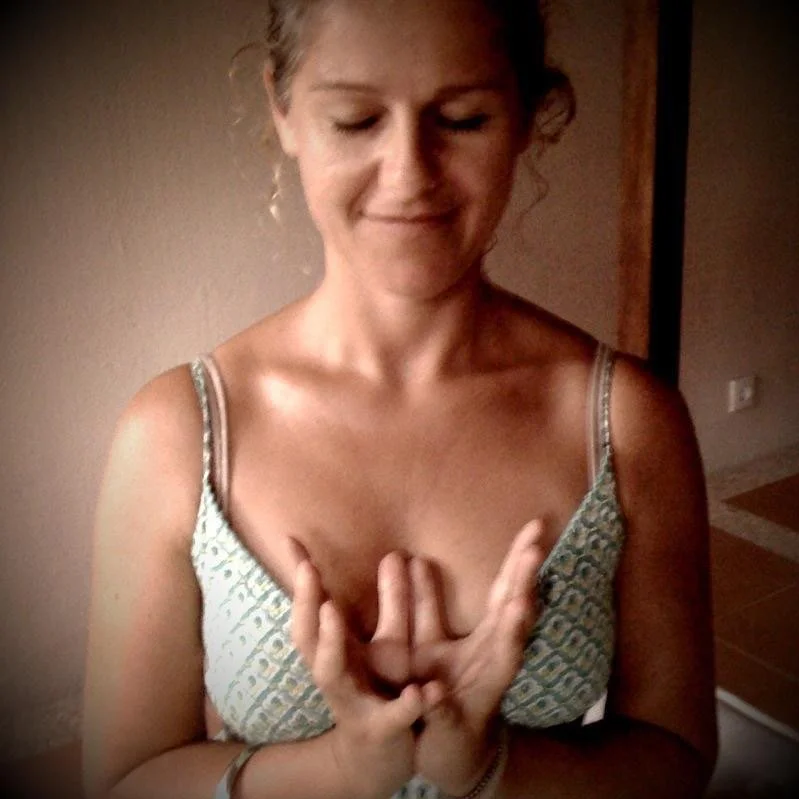
Introducing Myself + How Quiet Tides Was Born
My background is in almost 30 years of Yoga Teaching alongside qualifying as an Ayurvedic Practitioner and exploring meditation, Yoga Nidra, breathwork and somatic practices.
Over time, my work has naturally evolved. While these traditions continue to inform everything I do, the heart of my work now is guiding people back into relationship with themselves. The simplest way I can describe my medicine is as a Somatic Guide for Embodied Transformation. - creating spacious containers where people can slow down, listen deeply and reconnect with the wisdom already held within their bodies.
When people ask me how I became a yoga teacher, it can sound a bit cliché, but the honest answer is—it chose me.
In my early thirties, I travelled alone in India for six months and spent time in an ashram. I had a profound experience there that completely shifted my understanding of yoga. It became clear to me that there was far more to it than I had initially understood.
When I returned home, I noticed the ashram was running a yoga teacher training. I didn’t deliberate over it for long—it was a full-body yes. I couldn’t ignore it. I never went there intending to become a teacher. I didn’t even hold that identity for myself at the time. I simply knew I had to follow something deeper.
Even while I was on the training, I didn’t think, “I’m going to teach yoga.” I just felt completely in the right place—like something in me had come home. My sense was simply to learn, to absorb, and to be in it fully.
It was only afterwards, back home, that it became obvious: this wasn’t something to keep to myself. It was something to share.
For many years I taught physical yoga alongside meditation, yoga nidra, and breathwork.
About three years ago, I stopped teaching the physical postures. This wasn’t a decision I made intellectually—it was something my body made clear over time. I was also moving through menopause, and I began to notice a very honest shift in what my system needed. Less repetition and flexibility work, and more strength, steadiness, and simplicity.
In a way, the physical practice had served its original purpose. Traditionally, asana supports the body into a stable, healthy state so that one can sit in meditation for longer periods. At its root, yoga is not simply a wellness practice—it is a path of inner transformation and, ultimately, awakening.
I’ve always tried to stay close to that essence. I was trained in more traditional approaches to both yoga and Ayurveda, and while both have inevitably evolved and become more diluted in modern culture, I still feel a responsibility to honour the depth and integrity of what I was taught—while also recognising that we are living in a different time, and practices naturally evolve with us.
What became clear over time was that my own body was evolving too. It began to communicate very clearly that it no longer needed that same physical layer of practice in the same way. Instead, it wanted strength, grounding, and a different kind of internal focus.
And so I followed that.
Alongside all of this, I’m also just an everyday person and a mum. There have been periods in my life where I haven’t held a formal practice as steadily as I might have liked. But I’ve never really left it. I always return. Again and again.
Yoga nidra, in particular, has been a constant thread throughout everything—a place I come back to when life is full, messy, or uncertain. A way of remembering what is steady underneath it all.
And through all these years of practice—of turning inward, listening, softening, returning—it has become more and more obvious to me that this is really what the journey is about. Beneath all the striving, the healing, the searching, and the layers we accumulate through life, there is something profoundly simple waiting for us: the remembering of who we are.
For me, yoga has never ultimately been about perfect postures or self-improvement. It is about coming back into relationship with ourselves. Learning how to meet ourselves honestly, compassionately, and with love.
Through my work in Ayurveda, I also learned how to meet people in a more holistic way—understanding that what shows up in the body is often intertwined with the mental, emotional, and spiritual layers of experience. Not just symptoms, but a fuller expression of dis-ease.
Alongside the practical aspects of Ayurvedic work, I was also trained to listen and to hold space through a counselling-based approach. Over the years, this has deeply informed the way I work with people—not trying to fix or advise from above, but creating space for people to hear themselves more clearly and reconnect with their own inner knowing.
I’ve also continued learning throughout all these years. Returning to trainings, immersions, retreats, and studies across different traditions and approaches around the world—not from a place of collecting qualifications, but from a genuine love of learning and deepening understanding.
Each experience has shaped and refined the way I work. Over time, what I offer has become less about following a single method and more about weaving together everything I’ve lived, studied, practised, and embodied.
I think what I bring now is something quite unique. Not because it is entirely new, but because it has been slowly distilled through years of devotion, curiosity, experience, and real life.
Over time, all of this—yoga, Ayurveda, life experience, motherhood, study, and practice across many different lineages—began to distil into something simpler. Less about doing, and more about listening.
And this is how Quiet Tides came to be.
Not as a business idea or carefully constructed offering, but as a natural expression of everything I’ve lived, studied, questioned, practised, and returned to over the past 23 years.
It is an integration of devotion, experience, and deep listening. A space shaped not only by traditional teachings, but by real life—by motherhood, change, uncertainty, the body’s wisdom, and the continual invitation to soften and come back to myself again and again.
At its heart, Quiet Tides is about creating space for people to reconnect with themselves beneath the noise. Through yoga nidra, meditation, breathwork, seasonal gatherings, and quiet reflection, my intention is simply to offer practices and spaces that support rest, inner listening, gentle transformation and a remembering of who we are underneath all the layers.
The more I turn inward, the more I experience tat this path is not about becoming something else, but remembering what we already are. Beneath the layers, there is connection - to ourselves, to each other, to all living beings and to the Earth herself. Quiet Tides was born of that remembering.

Why Rest isn’t Always Enough: Stress, the Nervous System + Yoga Nidra
Most of us were taught that the solution to stress is relaxation.
Take a bath. Go for a walk. Breathe deeply. Go to bed early.
And while these all have real value, they don’t always reach the root.
Because stress isn’t only a mental experience. We now understand it lives in the body too — shaping the nervous system itself, and influencing the patterns through which we experience safety, connection, and our capacity to truly rest.
This is why so many people find themselves doing all the “right” things — meditating, resting, slowing down — and still feeling depleted, reactive, or stuck in the same inner cycles.
From a nervous system perspective, nothing is necessarily going wrong. It’s simply that the system hasn’t yet had the conditions to fully reorganise.
Yoga Nidra works differently.
Rather than offering a temporary state of relaxation, it guides the system into a threshold between waking and sleep — a liminal space where conscious effort begins to soften, and the nervous system can drop into deeper patterns of regulation.
In this state, the body is no longer simply relaxing. It is given the conditions to reset. Quietly. Gradually. At a level that reaches beyond the thinking mind and into the deeper architecture of stress itself.
This is part of the science that underpins Yoga Nidra — its ability to support nervous system regulation by moving awareness into states where repair and re-patterning become more available.
And it is at the heart of everything I offer through Quiet Tides — from nature-based rest and weekly online support, to seasonal group practice, and deeper 1:1 work that meets you in the places where change is asking to happen more fully.

A note on Yoga Nidra
At the heart of my work is a practice called Yoga Nidra, an ancient yogic practice originating in India that guides the body into deep rest while the mind remains gently aware.
I’ve been practising and teaching Yoga Nidra for over 20 years, and it has been one of the most profound and reliable tools in my own life. As well as being deeply restorative for relaxation and nervous system regulation, it has also helped me move beyond limitations held in the subconscious mind — gently bringing awareness to patterns and beliefs that can quietly shape how we live.
What I love most about Yoga Nidra is how simple and accessible it is. It can be practised anywhere, at any time, by anyone. There is no need for flexibility, strength, or previous experience — you simply lie down, get comfortable, and allow yourself to be guided. That is why it has become my favourite form of yoga: because it is truly for everyone.
While Yoga Nidra can be practised in many ways, there is something uniquely powerful about receiving it live. The quality of the spoken guidance — the pacing, tone, and presence of the voice — becomes part of the experience itself, helping the nervous system soften more deeply into trust and rest. Over the years, I’ve come to understand that my voice itself is part of how I hold this work — creating a space where people can soften, receive, and rest deeply.
Often described as “yogic sleep,” Yoga Nidra brings you into a state between waking and sleeping where deep restoration can happen. In that state, the body is able to soften out of stress, release held tension, and enter the kind of rest where repair and healing naturally begin.
People come to Yoga Nidra for many different reasons — to reduce stress and anxiety, improve sleep, restore depleted energy, find emotional balance, or simply create space to pause in an overfull life. Again and again, I see how this practice helps people reconnect with themselves in a deeply nourishing way.
There is nothing to achieve in Yoga Nidra. It is an invitation to rest, to receive, and to trust that profound change can happen in stillness.
At the heart of my work is a practice called Yoga Nidra, an ancient yogic practice originating in India that guides the body into deep rest while the mind remains gently aware.
I’ve been practising and teaching Yoga Nidra for over 20 years, and it has been one of the most profound and reliable tools in my own life. As well as being deeply restorative for relaxation and nervous system regulation, it has also helped me move beyond limitations held in the subconscious mind — gently bringing awareness to patterns and beliefs that can quietly shape how we live.
What I love most about Yoga Nidra is how simple and accessible it is. It can be practised anywhere, at any time, by anyone. There is no need for flexibility, strength, or previous experience — you simply lie down, get comfortable, and allow yourself to be guided. That is why it has become my favourite form of yoga: because it is truly for everyone.
While Yoga Nidra can be practised in many ways, there is something uniquely powerful about receiving it live. The quality of the spoken guidance — the pacing, tone, and presence of the voice — becomes part of the experience itself, helping the nervous system soften more deeply into trust and rest. Over the years, I’ve come to understand that my voice itself is part of how I hold this work — creating a space where people can soften, receive, and rest deeply.
Often described as “yogic sleep,” Yoga Nidra brings you into a state between waking and sleeping where deep restoration can happen. In that state, the body is able to soften out of stress, release held tension, and enter the kind of rest where repair and healing naturally begin.
People come to Yoga Nidra for many different reasons — to reduce stress and anxiety, improve sleep, restore depleted energy, find emotional balance, or simply create space to pause in an overfull life. Again and again, I see how this practice helps people reconnect with themselves in a deeply nourishing way.
There is nothing to achieve in Yoga Nidra. It is an invitation to rest, to receive, and to trust that profound change can happen in stillness.

A gentle Ayurvedic lens: emotions, digestion and sleep
A gentle Ayurvedic lens: emotions, digestion and sleep
There are times when life doesn’t feel “wrong,” but it does feel unsettled. Emotions linger beneath the surface, digestion feels off, sleep becomes light or fragmented. Nothing dramatic — just a quiet sense that the system is working a little harder than it needs to.
In Ayurveda, these experiences are not separate. How we feel, how we digest, and how we rest are intimately connected. When emotions are held or unprocessed, they often show up in the body — in the gut, the breath, or the quality of sleep. Likewise, when digestion is strained or the nervous system is overstimulated, emotions can feel closer to the surface and rest becomes elusive.
Rather than approaching this as something to fix, Ayurveda invites a gentler response: to listen.
Supporting emotional flow, digestive ease, and restful sleep is often less about doing more and more about creating the right conditions. Slowing the pace, softening the body, tending to rhythms, and allowing space for experience to be felt and digested — physically and emotionally.
In my work, Ayurvedic practices are offered quietly and intuitively, woven into reflective guidance and embodied support. The aim is not correction, but nourishment and care. Small shifts that help the system settle and remember its own capacity to restore balance.
When emotions are met with gentleness, digestion begins to steady. When the body feels safe enough to soften, sleep often follows. These changes rarely come through force — they arrive through attention, patience, and simple, intentional care.
This is where Ayurveda meets quiet ritual: supporting the whole system to feel held, so clarity and rest can return naturally.